Why Are CRT TV Screens So Laborious to {Photograph}?
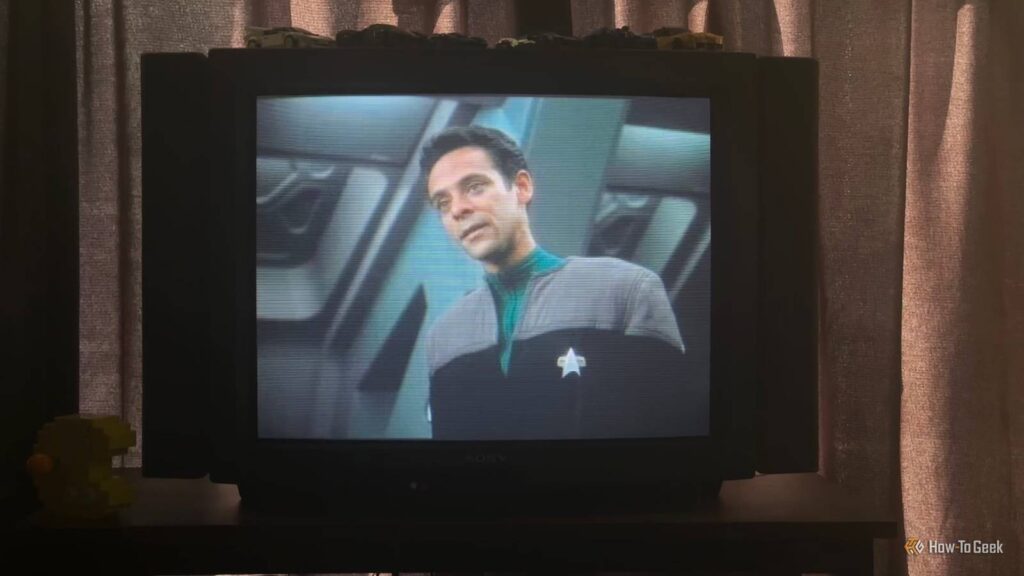
When you’re deep within the CRT passion like I’m now, you’ve got most likely realized that once you attempt to share your passion on-line, your screens do not fairly look proper on digicam. That is nothing new, and occurs due to the elemental manner CRTs work.
It is not simply you. When you watch previous motion pictures, reveals, or information segments with CRTs on digicam you may typically see them flicker or have a rolling bar operating from prime to backside that is not seen to the bare eye. Why does this occur, and is there some method to get round it?
How CRTs Show Photographs
To grasp why your images of a CRT do not look proper it’s a must to know a bit about how CRTs work, and the way trendy flat-panel shows do their factor.
I will not go into an excessive amount of technical element, as a result of we need not, however CRTs are price studying up on! So, with a contemporary flat panel show, your complete picture is represented by a grid of bodily pixels that every one change their state in unison. These screens are additionally known as “pattern and maintain” shows, as a result of they’ll maintain a picture completely secure till a sign tells them to alter it.
A CRT, however, does not present you your complete picture in a single go. As an alternative, it makes use of electron beams to attract the picture on glass coated with phosphors on the within. It begins at (your) prime left after which attracts traces from the highest to the underside of the show.
There is a very fashionable video by the Slow Mo Guys that reveals you precisely how a picture is drawn by a CRT, and you do not have to observe the entire thing, however I strongly encourage you to take action as a result of it is all very cool.
That is the important thing purpose your digicam has hassle capturing in a video or picture precisely what you see with the bare eye once you have a look at a CRT. Now, let’s break it down into the problematic elements.
The Refresh Price vs. Shutter Pace Conflict
The primary concern is that your digicam has a shutter (whether or not mechanical or digital) which controls how a lot mild is captured inside one picture or body of video. A sluggish shutter pace results in an extended publicity, and a quick shutter pace offers you a brief publicity. The sooner the shutter pace, the crisper the movement captured, however the much less mild every body or picture receives.
North American CRTs refresh your complete display at 60Hz, and so if your camera’s shutter speed is not in sync with the display refreshes of your CRT, you are going to catch it partway by every refresh. However, hold on, flat panel screens even have a refresh charge, so what offers? The rationale this is not a lot of a problem with LCD or OLED know-how, is that, as I discussed earlier than, the entire picture is refreshed without delay. So there isn’t any “scan line” to catch within the act of refreshing the picture.
Oddly sufficient although, the phenomenon of screen tearing occurs on flat-panel shows as a result of the video enter remains to be written to the display buffer the identical manner. So, if the frames being output out of your supply aren’t synced utilizing one thing like Vsync, you may find yourself seeing a line dividing the earlier and present frames, each seen on-screen on the similar time.
Phosphor Glow and Colour Points

Aside from having the ability to see the seen line the place the electron beam is doing its factor, you may additionally discover that the colour and brightness in your picture seems inconsistent. That is as a result of the phosphors within the display begin fading virtually instantly after being excited. Due to persistence of imaginative and prescient, you do not discover that components of the display aren’t as brilliant or colourful as the remaining. Nonetheless, your digicam is not fooled, and it needs to be fairly apparent.
Geometry and Curvature Distortion

Most CRTs are curved outward like a fishbowl, with solely a few of the final TVs and screens made providing a flat display. As a result of CRTs are fabricated from glass, you are prone to have issues with each a distorted picture and pesky reflections, relying on lighting circumstances and angle.
How Individuals Get Round It
OK, so how will you get round these points? The CRT refresh charge concern was so widespread, that some cameras even have a particular setting the place you’ll be able to tune the shutter till its in sync with the monitor you are filming. Newer cameras may not have this function although, and smartphones typically do not so far as I’ve seen. Personally, my trick is to make use of the “stay picture” or its equal function on a telephone. That is the place the telephone takes a brief video, and also you principally decide the most effective body in that video as your picture. This makes it straightforward to easily decide the second you’ll be able to’t see the scan line, however solely works for images, clearly.
Decreasing the distinction on the CRT will help remove bloom and scale back drastic variations in colour and brightness in your picture. To reduce reflections, you may must play with the lighting within the room. The darker the room, the much less vulnerable to reflection the display will likely be.
In skilled settings (e.g. TV reveals or film units) particular gear equivalent to a “genlock” can be utilized to sync a number of shows and digicam gear to a single grasp timing sign, however when you’ve got entry to that, you already know greater than we have mentioned on this article.
When you’re simply attempting to make a screenshot appear like it was displayed on a CRT, you are higher off simply utilizing some form of CRT filter, quite than attempting to movie it on an actual CRT. It is not like anybody viewing it on a flat panel can see what an actual CRT picture seems like anyway.
When you’re attempting to share a picture of a CRT display for any purpose, it may additionally assist to not sweat attempting to get the proper picture. I believe the way in which CRTs look in images and movies are simply a part of the appeal anyway, so do not spend ages nitpicking. The broad strokes will do exactly fantastic!